The forest
The forest that resists fire
Before the eucalyptus, the Portuguese landscape was made of cork oaks, deciduous oaks and strawberry trees — species that evolved to live with Mediterranean fire, not to feed it.
Scroll to enter the forest
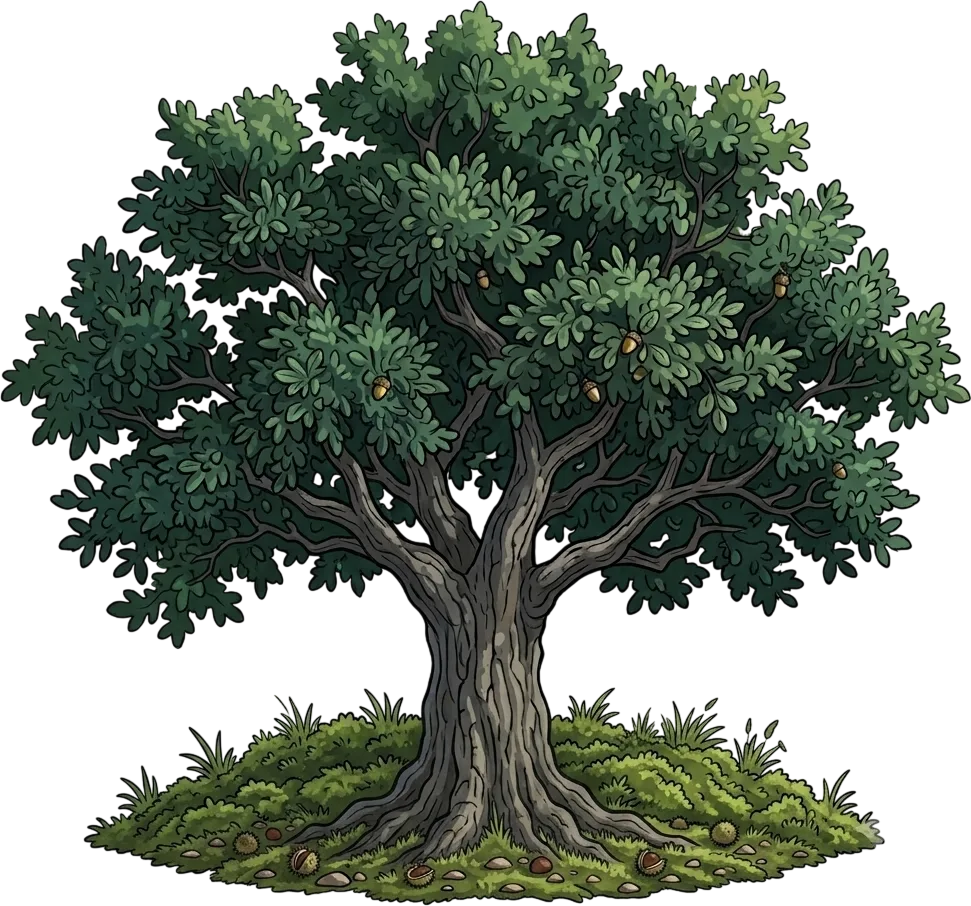
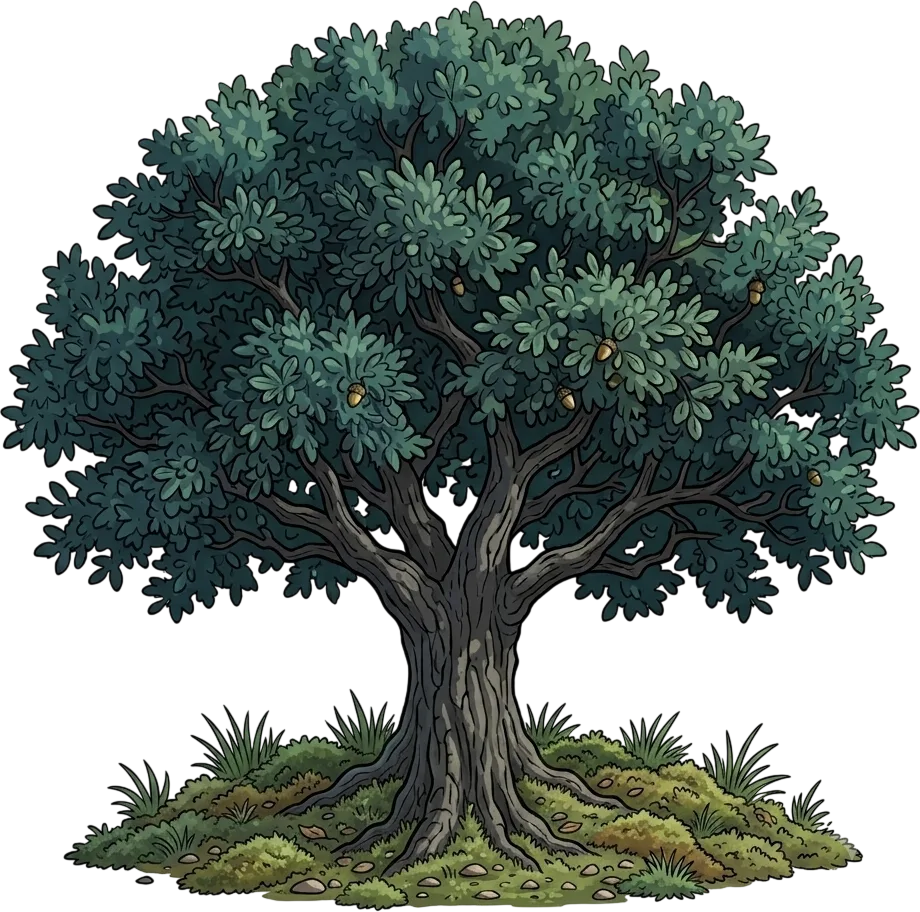
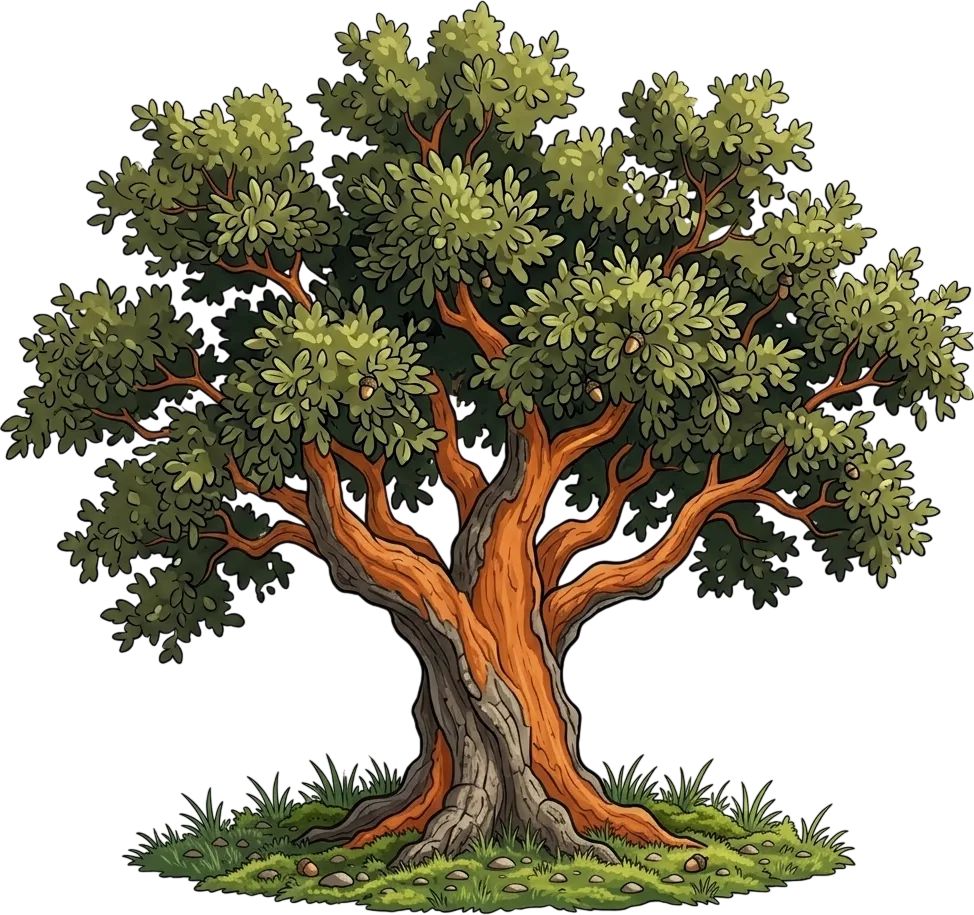
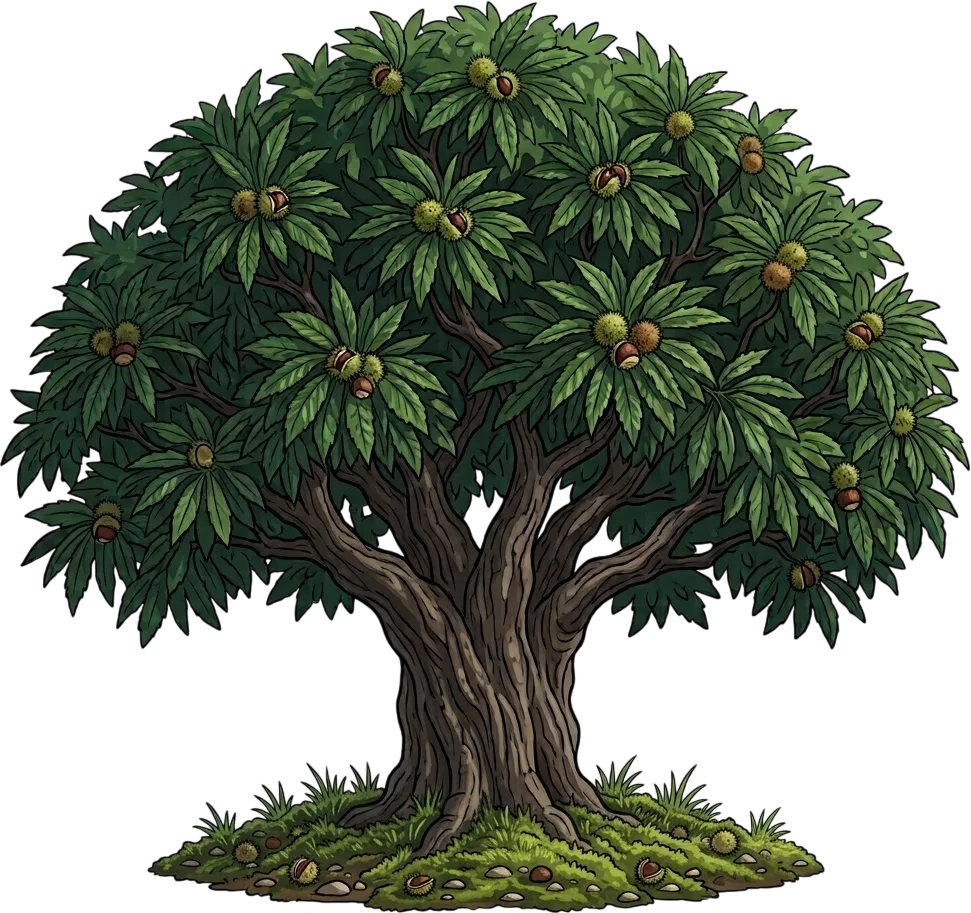
Through the thin native vegetation, the familiar landscape shows through: a eucalyptus plantation in flames.
02 · The invasion
The natives move out, the eucalyptus moves in
Today the eucalyptus is Portugal's most common forest species, covering about 845,000 hectares — roughly a quarter of the country's entire forested area.
In little more than half a century, Eucalyptus globulus went from botanical curiosity to dominant landscape. Where there was oak, scrub and cork oak, planted rows now line up, cut on short cycles to feed the pulp mills.
A forest planted to be cut, not to last.
- Almost a tenth of the whole territory of mainland Portugal.
- More than one and a half times the entire Algarve region.
- The equivalent of 84 cities of Lisbon side by side.
03 · The cycle
Fire helps the eucalyptus win
Eucalyptus resprouts vigorously after fire and its regeneration benefits from the disturbance, creating a cycle in which burning favours the eucalyptus itself over native species.
Each wildfire clears out the competition and hands the ground to the shoots and to the seeds the heat releases. The more it burns, the more eucalyptus takes over — and the more eucalyptus, the faster and farther it burns again. It is a cycle that feeds itself.
The more it burns, the more eucalyptus. The more eucalyptus, the more it burns.Why does this happen?
04 · Fire and seed
How the eucalyptus uses fire
Eucalyptus globulus doesn't just survive fire — it puts it to work. Its fibrous bark peels off in strips that burn and fly kilometres ahead of the fire front, starting new ignitions long before the flames arrive — the very mechanism that helped the Pedrógão fire spread.
After burning, it resprouts vigorously from buds protected under the bark and from a lignotuber at the base of the trunk, while heat-opened capsules release seeds onto ground cleared of competition. Where the native forest takes years to return, the eucalyptus reclaims the land in a single season.
Fire is not the eucalyptus's enemy — it is its sower.
05 · Who profits
Who profits from the eucalyptus
The industry is concentrated in a few big players — Navigator and Altri in pulp and paper production, with CELPA representing the sector.
Pulp and paper rank among Portugal's biggest industrial exports, and eucalyptus is the raw material of that chain. The model is profitable for those who process it — but the fire risk falls on those who live among the plantations.
The Navigator Company1953
Navigator (formerly Portucel, founded in 1953 and renamed in 2016) was a global pioneer of eucalyptus pulp and is today Portugal's largest producer of fine printing and writing paper and one of the country's biggest exporters, with the eucalyptus chain at the heart of the business.
5Navigator- 2024 revenue
- ≈ €2bn
- European share
- ~29% paper · ~16% pulp
- Forest managed
- ≈ 109,000 ha
Altri2005
Altri, incorporated in 2005, is Portugal's second large producer of eucalyptus pulp, operating the mills of the Celbi, Caima and Celtejo brands.
7Altri- Founded
- 2005
- Market cap
- ≈ €1bn
- Capacity
- ≈ 900k t/yr
CELPA — Associação da Indústria Papeleira
CELPA is the association representing the Portuguese pulp and paper industry, publishing the sector's annual Statistical Bulletin.
3CELPA
06 · The fire
Pedrógão Grande, June 2017
On 17 June 2017, a wildfire in Pedrógão Grande killed 66 people, many while fleeing along the roads. Long-distance ember showers — aided by the eucalyptus's bark — opened new fronts ahead of the flames.
It was not an isolated case. In October of the same year, a second wave of fires swept the centre and north of the country, and 2017 closed as the deadliest year on record — more than a hundred lives lost to fire. Amid the destruction, the cork oaks were left standing.
Amid the destruction, the cork oaks remained standing.
07 · Why?
The pulp economy
From the 1960s onwards, incentives for the pulp industry and the eucalyptus's rapid growth led thousands of smallholders to plant it, replacing scrubland and native forest.
The logic is simple and relentless: eucalyptus grows fast and pays fast, ready to cut in about a decade, while a cork oak takes close to 25 years to yield its first cork. For each landowner it was the rational choice — and the whole country made it at the same time.
And there is an even easier shortcut: many owners, with no time or will to clear and manage their woodland, simply lease the land to a big pulp company, which plants it with eucalyptus and pays rent. The land earns without any work — but it stops being a forest and becomes a factory.
Why do landowners accept this?08 · The land
The maths that don't add up
Leasing land to a pulp company looks, at first glance, like a good deal for anyone who wants no work: Navigator alone manages about 109,000 hectares of forest, of which close to 50,000 are plots leased from private owners. The owner collects a fixed annual rent — or a share of the timber's value at harvest — on contracts that can run for 25 years.
But the long-term maths tell another story. Eucalyptus is cut every 10 years and, with each rotation, drains water and nutrients from the soil. Cork takes 25 years until the first harvest — but after that a cork oak keeps giving cork for over a century. And cork is the jewel of the Portuguese forest: it exported 1,148 million euros in 2024 alone.
The monoculture pays the landlord little and charges everyone else dearly: depleted soil, drier streams, lost biodiversity, and a fire risk that falls on the people living beside the plantations — not on those who profit from them.
You collect a small rent; the landscape pays the rest.
09 · The natives
The species that fight fire
Not all trees burn the same way. These native species resist fire, resprout after it or act as natural barriers — Portugal's true defence infrastructure against wildfire, and it grows on its own.
- Fire-resistant
Cork oak
Quercus suber
The national tree — the cork bark that survives fire.
Cork is a natural insulator: the thick bark protects the trunk and the buds, and the tree resprouts after fire. It has been Portugal's national tree since 2011, and the country is the world's largest cork producer, with about half of global output.
- Resprouts after fire
Holm oak
Quercus rotundifolia
The dry guardian of the montado — resistant to drought and heat.
A companion to the cork oak in the southern montado, the holm oak tolerates prolonged droughts and poor soils. After burning it resprouts from the stump, and its acorns feed free-ranging pigs. The cork and holm oak montado is one of the habitats protected by the Natura 2000 network.
- Resprouts after fire
Deciduous oaks
Quercus robur, Q. pyrenaica, Q. faginea
The deciduous woods of the north and interior — humid and cool.
The deciduous oak woods — pedunculate, Pyrenean and Portuguese oak — dominated the north and interior of Portugal before the spread of eucalyptus and pine. Their humid understorey and dense shade hold moisture, lowering fire intensity compared with eucalyptus stands.
- Resprouts after fire
Strawberry tree
Arbutus unedo
The shrub that resprouts after fire — and yields medronho brandy.
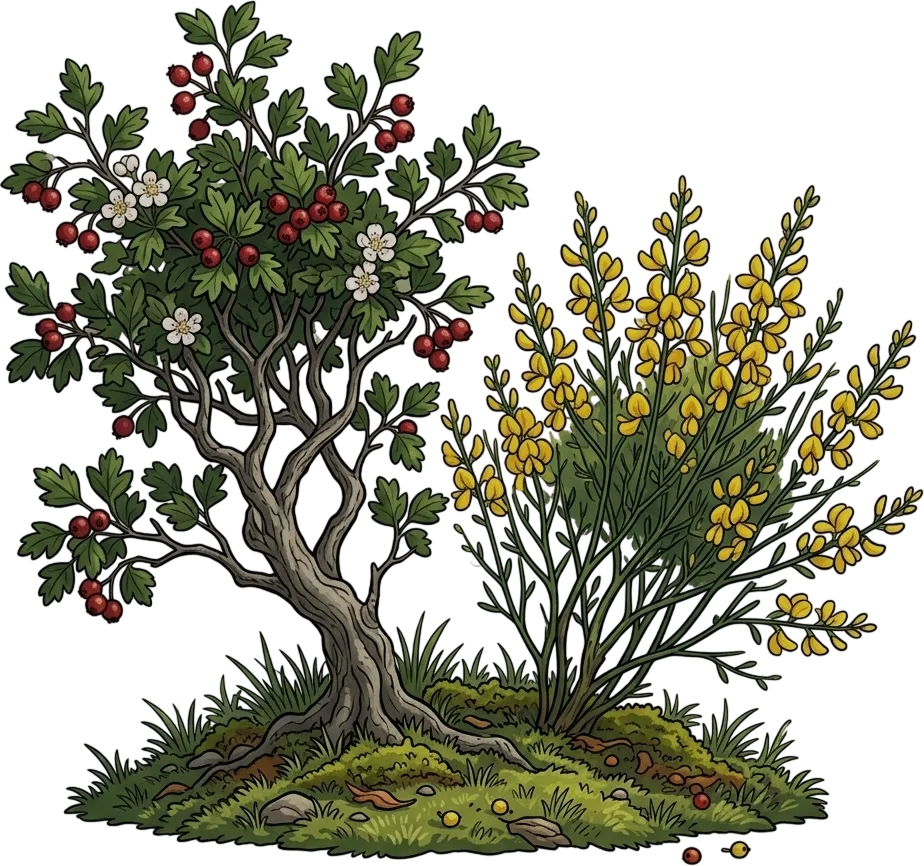
A fire-resilient Mediterranean species: it resprouts vigorously from the stump after burning. Its fruit is distilled into the traditional medronho brandy, and it is now promoted in low-flammability plantations as an economic alternative to eucalyptus in high-risk areas.
- Natural firebreak
Riparian gallery
Fraxinus angustifolia, Alnus glutinosa, Salix, Populus
Green corridors along the water — natural firebreaks.
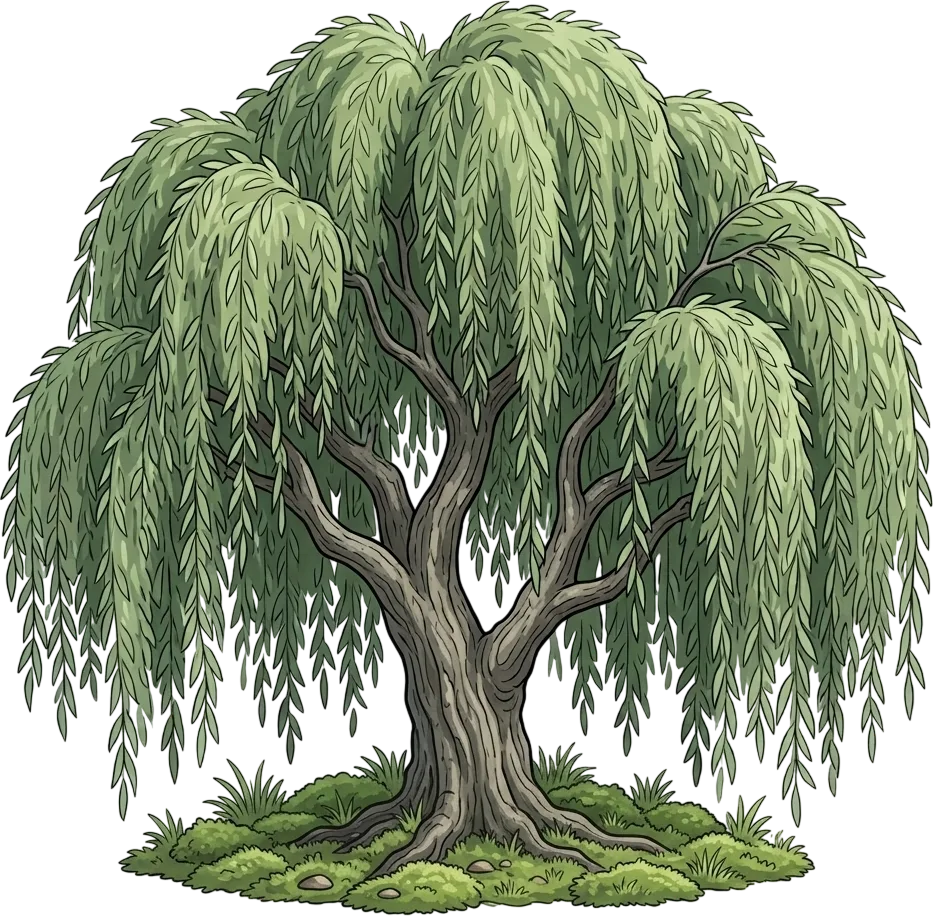
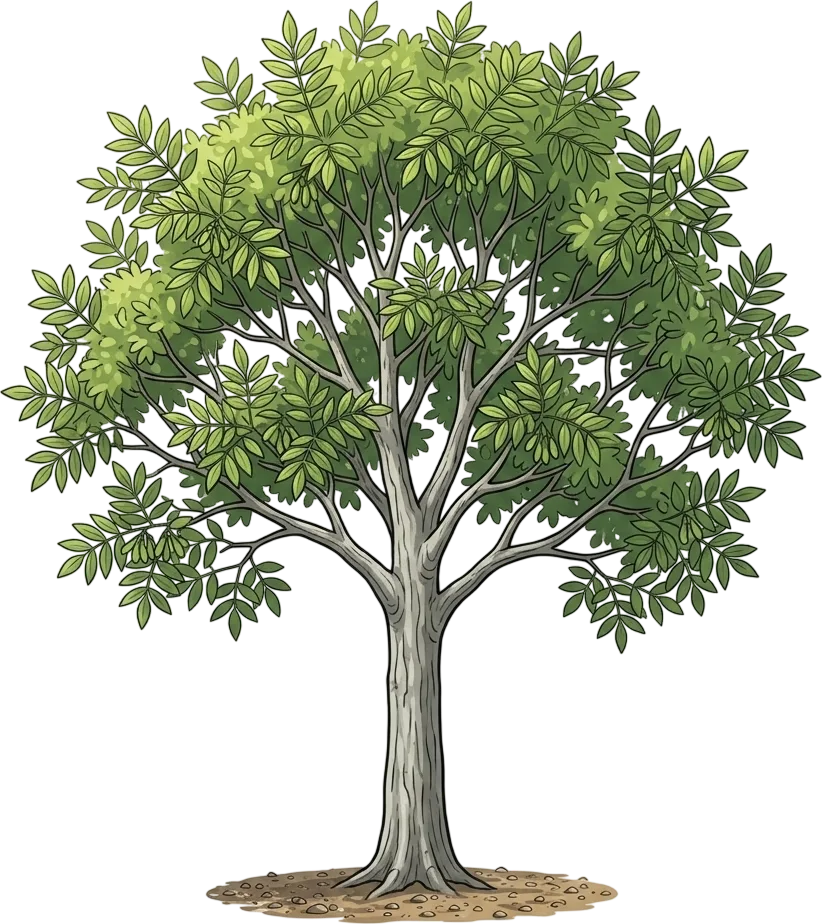
Ash, alder, willow and poplar along watercourses keep humid foliage through the summer. These galleries act as natural firebreaks, slowing or halting the advance of the flames, while also sustaining biodiversity and water quality.
10 · The neighbours
Same climate, different forest
Spain, Italy and Greece share our Mediterranean summer, our drought and our fire. They do not share our forest. In Portugal, roughly two thirds of the forest area was planted by people; in Greece it is less than a twentieth.
The difference is not climatic, it is economic. Where our neighbours let the forest regenerate itself, Portugal planted it — and planted it largely to feed mills.
| Country | Planted forest | Total forest area |
|---|---|---|
| Portugal | 68.1% | 3,312,000 ha |
| Spain | 13.9% | 18,572,170 ha |
| Italy | 6.7% | 9,566,130 ha |
| Greece | 3.6% | 3,901,800 ha |
"Planted" means put there by people — it does not mean exotic. Much of the Portuguese figure is maritime pine, which is native. What these numbers show is not that the forest is foreign, but that almost none of it made itself.
Sources23FAO FRA 202011 · The people
The forest belongs to people
Even those who lease their land to a big company come out losing in the end: they get little in return for an enormous environmental cost that only comes due decades later. We live too short to see the damage up close — but we are already seeing what an industry sown half a century ago left us.
The forest belongs to people, not to companies.
12 · The resistance
Who is fighting back
Against the monoculture there are those who plant, those who buy abandoned land to let it become forest again, and those who changed the law. The resistance is scientific, grassroots and political — and it spans the country from north to south.
Quercus — Associação Nacional de Conservação da Natureza1985
Quercus, founded in 1985, is one of Portugal's oldest environmental NGOs and campaigns for native forest and against the eucalyptus monoculture.
13QuercusZERO — Associação Sistema Terrestre Sustentável2015
ZERO, founded in 2015, works on forest, climate and land-use policy, advocating for reducing the eucalyptus area in high-risk zones.
14ZEROMontis — Associação de Conservação da Natureza
Montis practises land stewardship: it acquires or manages abandoned plots to restore low-flammability native forest.
15MontisATN — Associação Transumância e Natureza
ATN manages the Faia Brava Reserve, in the Côa valley — Portugal's first private protected area — restoring habitats and reintroducing wild herbivores.
16ATNPlantar uma Árvore
The Plantar uma Árvore association runs reforestation drives with native species, involving volunteers in the recovery of burnt areas.
17PlantarLei n.º 77/2017 — regime de arborização2017
Following the 2017 fires, Law no. 77/2017 amended the legal regime for afforestation and reforestation, halting the net expansion of the eucalyptus area — new plantations were, as a rule, made conditional on replacing existing eucalyptus stands.
18Lei 77/2017
13 · What you can do
Start with one of these
Planting native species, supporting conservation and land-stewardship groups, and choosing native-forest products — such as cork — are concrete ways to reverse the monoculture.
No single gesture reverses half a century of eucalyptus. But choosing cork over plastic, supporting those who restore native forest, and knowing the origin of what you buy are decisions that, added together, shift demand. And demand is what, in the end, decides what gets planted.
Plant and rewild
The most direct route: put native trees in the ground, or fund those who do.
Join a planting day
Plantar uma Árvore runs native-species reforestation drives and takes volunteers for the recovery of burnt areas — no experience and no land of your own required.
17PlantarSupport land stewardship
Montis buys or manages abandoned plots and lets them return to low-flammability native forest. Supporting it buys time for land nobody is managing.
15MontisVisit and support Faia Brava
ATN manages the Faia Brava Reserve, the country's first private protected area — visits and donations fund habitat restoration in the Côa valley.
16ATN
If you own land
Around 91% of the forest is privately owned. If any of it is yours, what grows there is literally your decision.
Think twice before leasing for eucalyptus
Forest leasing programmes guarantee a steady rent for decades, but lock the land into eucalyptus for that whole period — the environmental cost only comes due long after the contract is signed.
6Clube PFPut idle land into stewardship
Owners of small, unused plots can hand them to land-stewardship associations, which take on management and restoration without any transfer of ownership.
15MontisJoin a commons or joint-management scheme
Portuguese forest is mostly scattered smallholdings, which makes management at scale impossible. Commons and owner groupings restore that scale without selling the land.
11Florestas.pt
Consume differently
Demand decides what gets planted. Yours included.
Choose cork over plastic
Cork comes from cork oaks that are not felled to produce it — the tree is stripped and lives on, so demand for cork keeps montado standing.
4APCORAsk where paper and timber come from
Portuguese paper and pulp rest largely on the eucalyptus chain. Knowing the origin — and preferring certified native-forest suppliers — changes the signal that reaches the producer.
3CELPA
Civic and political
The eucalyptus area stopped growing because the law changed. Laws change under pressure.
Join Quercus or ZERO
Quercus (1985) and ZERO (2015) campaign for native forest and take part in public consultations on forest and land-use policy.
13Quercus14ZERODemand Law 77/2017 is enforced
Law no. 77/2017 halted the net expansion of eucalyptus: new plantations must, as a rule, replace existing stands. It is worth exactly as much as its enforcement.
18Lei 77/2017Report irregular plantings to ICNF
Afforestation and reforestation operations require ICNF authorisation, which makes unauthorised plantings reportable to the forestry authority.
18Lei 77/2017
Read further
This page's primary sources, if you would rather verify than believe.
National Forest Inventory (IFN6)
The official survey of what grows in Portugal and over what area — the basis for nearly every figure on this page.
1ICNFIndependent Technical Commission reports (2017)
The independent parliamentary analysis of the June and October 2017 fires, including Pedrógão Grande.
8CTI 2017FAO — Global Forest Resources Assessment 2020
National reports on a harmonised methodology — what makes it possible to compare Portugal with Spain, Italy and Greece without comparing different definitions.
23FAO FRA 2020
Where the eucalyptus left its mark, the wound slowly heals over with native forest.
Every figure and claim on the site, linked to its origin. Tap a number anywhere on the page to jump to its source.
- 1.ICNF — 6.º Inventário Florestal Nacional (IFN6) (2019)
- 2.Literatura sobre ecologia do fogo mediterrânico: inflamabilidade comparada, regeneração pós-fogo de espécies autóctones (rebentação de toiça e raiz) e de Eucalyptus globulus (talhadia e libertação de sementes pelo calor)
- 3.CELPA — Associação da Indústria Papeleira, Boletim Estatístico
- 4.APCOR — Associação Portuguesa da Cortiça
- 7.Altri SGPS — Relatório e Contas / Euronext Lisbon
- 8.Comissão Técnica Independente (Assembleia da República) — relatórios dos incêndios de junho e de outubro de 2017 (2017)
- 9.ICNF — estatísticas de área ardida (2017)
- 10.APCOR / INE — exportações portuguesas de cortiça (noticiado pela RTP/Lusa) (2024)
- 11.Florestas.pt / ICNF — estrutura da propriedade florestal em Portugal (privada, fragmentada)
- 12.DGT — Carta Administrativa Oficial de Portugal (CAOP), áreas administrativas
- 13.Quercus — Associação Nacional de Conservação da Natureza (1985)
- 14.ZERO — Associação Sistema Terrestre Sustentável (2015)
- 15.Montis — Associação de Conservação da Natureza
- 16.ATN — Associação Transumância e Natureza / Reserva da Faia Brava
- 17.Plantar uma Árvore — associação de reflorestação com espécies autóctones
- 18.Diário da República — Lei n.º 77/2017, de 17 de agosto (2017)
- 19.Assembleia da República — Resolução que consagra o sobreiro como Árvore Nacional de Portugal (2011)
- 20.ICNF — Habitat 6310 'Montados de Quercus spp. de folha perene' (Rede Natura 2000)
- 21.ICNF — programas de valorização do medronheiro como espécie de menor inflamabilidade
- 22.APA — gestão de galerias ripícolas / literatura sobre corredores ripários como corta-fogos
- 23.FAO — Global Forest Resources Assessment 2020, relatórios nacionais (Portugal cb0048en, Espanha cb0103es, Itália cb0012en, Grécia ca9999en), Tabela 1b «Forest characteristics» (2020)
Last updated · Made by Daniel Bastos